WHAT IF INFLATION IS ACTUALLY GOOD FOR THE ECONOMY?
- Dương Yên Thy
- 28 thg 12, 2025
- 3 phút đọc
by Dương Yên Thy and Cao Vũ Tuấn Vinh

What is inflation?
Inflation
The sustained increase in the general price level in a period of time.
Note that:
Inflation is NOT defined as “a decrease in the value of a currency” - this is the consequence, not the definition, which will be discuss later on.
“General price level" refers to the prices of all goods and services in the economy, not just single prices.
Inflation will reduce the value of money: with $5 before inflation, one can buy a cup of coffee, but after inflation, when prices rise, $5 cannot be used to buy the same cup of coffee.
How do we measure inflation?
Suppose there is a basket that collects all of the regular goods and services that an average consumer would consumes, for example staple food, water, clothes, etc.
If we measure the average change in prices over time of the basket goods, the consumer price index (CPI) is derived.
CPI is the key indicator for measuring the rate of inflation.
Consumer price index
A measure of the average change in prices over time for a representative "basket" of goods and services that an average consumer consumes.
The two types of inflation
Demand-pull inflation:
Occurs when the aggregate supply (AS) of goods and services does not rise in line with the aggregate demand (AD).
As a result, the aggregate demand curve shifts to the right, leading to a higher price level.
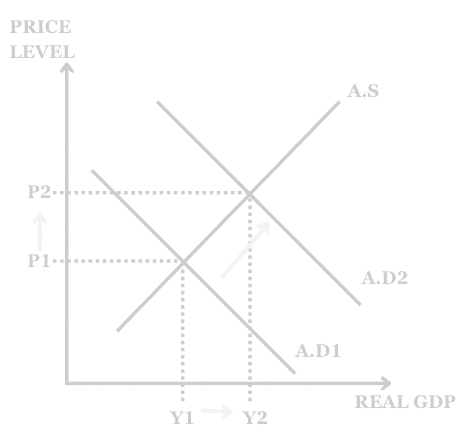
Demand-pull inflation:
Occurs when the aggregate supply (AS) of goods and services fall faster than the aggregate demand (AD).
As a result, the aggregate supply curve shifts to the left, leading to a higher price level.

Note that: “Aggregate” means the total amount. This because inflation are analyzed on the whole economy.
The pros and cons of inflation
[+] | [-] |
1. Increase economic growth: As we have analysed in the aforementioned demand-pull inflation, when demand increases, the real output may increase → signaling economic growth. 2. Reduce unemployment: As real output increases, more workers are needed for higher production. Thus, unemployment may fall. 3. Reduce the burden of debt: Inflation leads to a fall in the value of money as a consequence. This means the value of debt is reduced → borrowers benefit. | 1. Reduce purchasing power: As prices increase while our income stays the same, we can buy less with our money. 2. Increase in inequality: Low and fixed-income earners will suffer harder than asset owners. 3. Economic uncertainty: Price changes make firms reluctant to invest and make it harder to plan for the long run.
|
Conclusion
Inflation is a sustained rise in the price level over a period of time, its rate is measured by the consumer price index (CPI).
There are two types of inflation: Cost-push and demand-pull inflation.
Inflation is not always bad. It can be beneficial or unfavourable for the economy depending on the state of the economy, the macroeconomic goals, etc.; if it is kept at a low level, it can boost economic growth. Otherwise, the economic stability can be threatened.
Bình luận